Blog

7 Reasons to be good at Negotiation: Part 7c – All you need is Love… and Minerals

In the final part of my blog series featuring content edited out of my book The Yes Book (now out on Random House), I take a look at China’s behaviour in relation to its negotiations over shortages of essential modern minerals required for industrial production. It seems very much to be a mixture of “pressures” and “incentives” – a push-me, pull-you approach.

Some nations are stockpiling important materials and restricting exports in an attempt to protect their own businesses from increasingly fierce global competition. Among the countries known to be stockpiling resources, Japan has said it is storing supplies of seven rare materials it believes are essential to modern life and industry. China is also accused of this behaviour. The United States, the European Union and Japan filed complaints last year with the World Trade Organization charging that China is limiting its export of rare earths, minerals that are vital to the production of technology components.

China has a strong hold on the global supply of 17 rare earth minerals that are essential for making high-tech goods including hybrid cars, weapons, flat-screen TVs, mobile phones, mercury-vapour lights, and camera lenses. However, China has cut its export quotas of these minerals over the past several years to cope with growing demand at home, though the government also cites environmental concerns as the reason for the restrictions. U.S. industry officials suggest it is an unfair trade practice, against rules established by the WTO, a group that includes China as a member.

China is also adopting a more subtle approach to the problem though. Chinese are arriving in Africa in ever greater numbers. An estimated one million are now resident in Africa, up from a few […]
By |April 9th, 2013|Blog|Comments Off on 7 Reasons to be good at Negotiation: Part 7c – All you need is Love… and Minerals

Thatcher ‘The Negotiator’ – When a Strength can also be a Weakness…

The death of Baroness Thatcher has prompted a review of her negotiating style. She was widely regarded as being combative, stubborn, uncompromising – a real “Iron Lady”.

Some commentators have described this kind of approach as a great strength which helped make Britain respected on the world stage. Others have said that this “precipice” style of negotiation was her Achilles heel and led to her downfall.

So who is right? Certainly I believe that a collaborative style of negotiation is generally appropriate for a modern inter-dependent world. However, I also believe that it’s right to stand up to tough guys who try to push you around – if you don’t make their behaviour the issue then they will keep pushing you. The real skill as a negotiator is to have the judgement to know when to push tough guys back, and when to collaborate.

Viewed in this context it is a bit easier to evaluate Baroness Thatcher’s approach. There is no doubt that she knew when to stand up to tough guys – whether that was the Argentinian Junta invading the Falklands, EU commissioners or other EU leaders trying to rail-road Britain into unfavourable agreements, or bellicose Union leaders like Arthur Scargill. Standing up to these individuals ultimately made them back off and earned Mrs Thatcher many plaudits.

However, you need more than one gear to drive with when you are a negotiator. Not everybody who has a different point of view to you is a tough guy who needs to know that you will not blink. Often if people genuinely disagree with you that is a signal for a co-operative negotiation approach which can enable everyone to get more of what they want, rather than an attritional […]

By |April 10th, 2013|Blog|Comments Off on Thatcher ‘The Negotiator’ – When a Strength can also be a Weakness…

The Chaos Stage in a Negotiation

All negotiations tend to follow seven sequential stages. Every negotiation has to go through all of these stages whether the participants realise it or not. Problems arise when one or both sides don’t know what stage they are at, or try to skip a stage. Then the chaos stage takes over.
The seven stages are:
Preparation
Climate setting – what is the atmosphere in which the negotiation is to be conducted. Will it be open and friendly? Cool and objective? Hostile or cheeky? What is the timescale for the deal, and the agenda? Who is going to be involved and what’s the venue?
Exploring wants and needs – what are the items people want in the deal, and more importantly why do they need it? If they want a certain price and you can work out why they need that price then maybe there are other ways apart from price to meet that need
Coinage – are there any concessions you can make which are of low value to you but meet a high value need or motivation on the other side
Bidding – making offers
Bargaining
Closing the deal

Chaos reigns if people skip the first stage of preparation. Many people feel they don’t have time for preparation in our busy world full of emails to send, calls to make and meetings to attend. However, missing out on preparation means preparing to miss out:

Who is in your team? What roles will they play? What’s the bargaining power on both sides? What are your risks of doing the deal? What are the alternatives? What is your ideal outcome? What is your bottom line? What does the other side really need? Is there any history? How are they likely to behave as individuals? All […]

By |September 16th, 2013|Blog|Comments Off on The Chaos Stage in a Negotiation

The Importance of Harmony and Team Unity in Negotiation

We all negotiate as a team sometimes. This is when negotiations can go spectacularly wrong, with in-fighting and disunity causing chaos. Sometimes members of the team will deliberately starve other members of information or involvement. Sometimes they may even be more preoccupied with making a colleague look bad then getting the right result for the team.

There are a couple of tips for avoiding this;

1. Come prepared

First of all, preparation is even more important in team negotiations than in other types of negotiation. If the team is not prepared it is uncanny how the other side will gravitate towards the least prepared member in order to exploit the resulting lack of organisation. In this sense “the team” includes everybody on your side who has a stake in the outcome and not just those doing the negotiation directly – so make sure you involve everybody: stakeholders who feel left out may sabotage the deal later if they feel aggrieved.

That preparation must include:

All the usual elements of agreeing timing, roles, agenda, approach, risks and also agreeing a bottom line.

Making sure that all participants are aligned behind the team’s negotiating objectives. If someone doesn’t believe in the team position than the other side will sniff them out and exploit the gap. If someone is not aligned then don’t parade them in front of the other side – they should stay out of the face to face negotiation and their objections can be dealt with behind the scenes.

If, despite this preparation, disunity breaks out in a meeting with the other side, call a break immediately and deal with the problem internally. There is nothing worse than conveying disagreement amongst yourselves to the other side. It looks weak […]

By |August 2nd, 2013|Blog|Comments Off on The Importance of Harmony and Team Unity in Negotiation

Clive Rich on BBC Radio

In March of this year I was interview by Mai Davies of BBC Wales. We discussed many things related to negotiation – it was great fun.

Have a listen below.

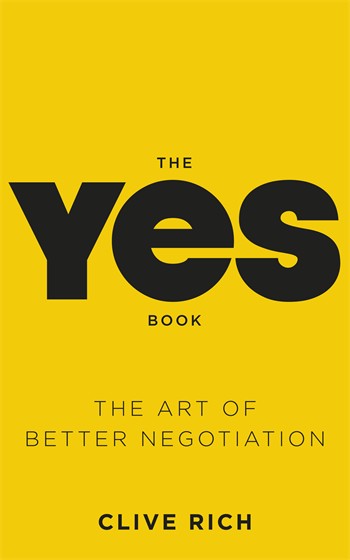
If you want to know more about negotiation, I strongly recommend you take a look at the Yes Book. It is my 30 years of experience compressed into a great read, so that you can easily become a better negotiator.

Get the Yes Book from Amazon

By |July 27th, 2013|Advice, Blog|Comments Off on Clive Rich on BBC Radio